
The Shadows
A Dash McCain Noir Occult Detective Story

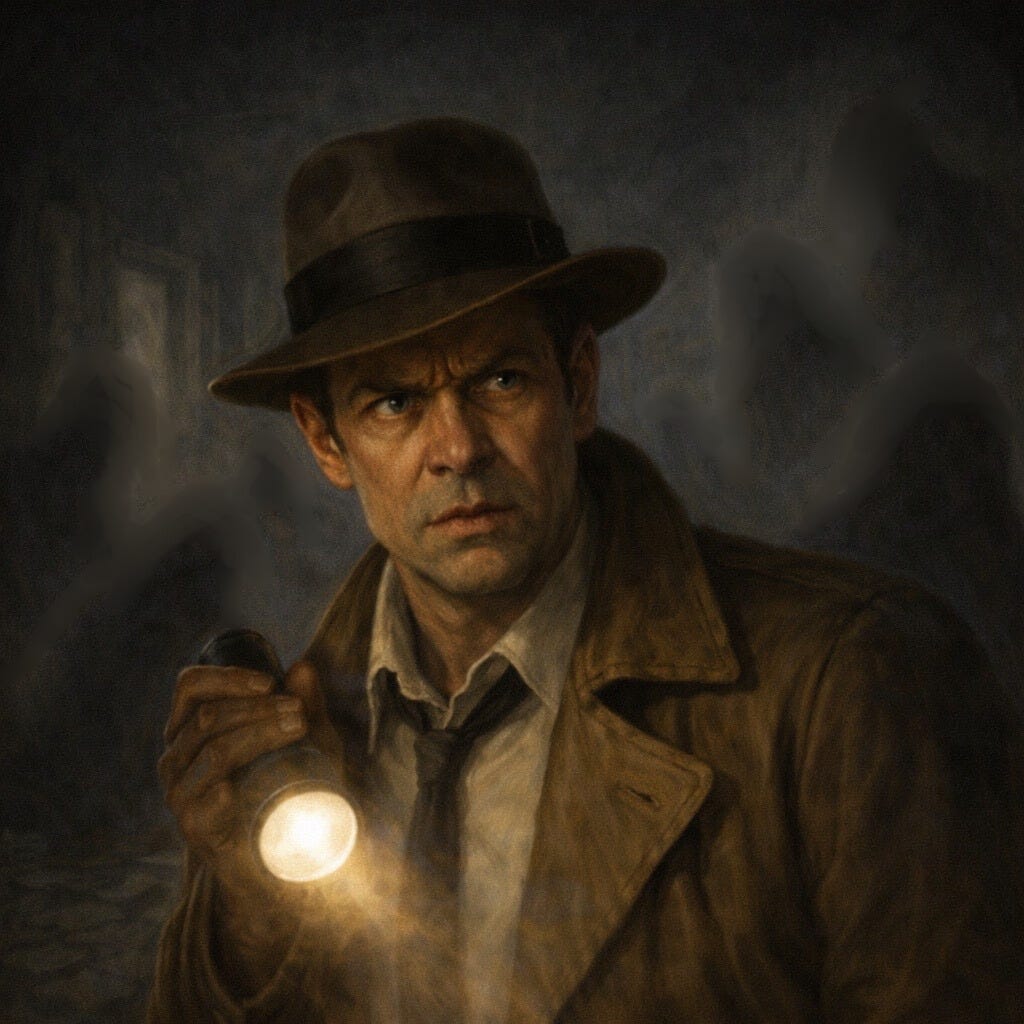
New York, April 1972
The good people of our lovely city like to pretend that things are solid, fixed, predictable—like bricks, mortar, death, and taxes. Just ask the mayor or the chief of police. But sometimes the darkness presses in just a little too close, and you know, down deep, that things are not what they seem.
Take something as simple as a shadow. I can tell you from hard experience that there are shadows and then there are shadows—not just the partial absence of light but the total presence of darkness.
That’s what I saw, what I lived through, just barely, on a stormy night in an abandoned building out in the middle of nowhere.
And I’m still here to tell the tale.
It all began because someone needed my help and because of a little whisper always in the back of my mind since I was a boy: You can see things others can’t, and you can see them for a reason.
I’m a private investigator by trade, and my clients were the Bainbridge siblings of Westport, Connecticut—upper-crust and struggling to hold on to the family’s old position in the world.
The two had inherited a property from their late uncle. A long-abandoned building up in a forgotten part of the Bronx… Hunter Island out on Pelham Bay. It was the boonies, as they say. The last stop before the raccoons start filing taxes.
The old place had been the home of the Hunter’s Haven Convalescent Institute until it closed permanently in the 1940s. It had been empty since then—sitting on the shore above the salt marshes and the tidal pools, dense forest behind, lonely and isolated.
It was said to be haunted, so the case was right up my alley.
The Bainbridges came to our office looking like they thought they’d stepped into the wrong part of town—which they definitely had. Our neighborhood sports some of New York’s finest purse-snatchers, and the facilities of McGonigal & McCain, Private Investigators, had seen much better days even when Ike was president.
But they came because they needed help.
Michael Bainbridge, forty-ish, had the slicked-down air of a man who sold securities for a living. His younger sister Vivienne stood out like a delicate ghost of debutante balls past and seemed like she was always braced for disasters that were all but inevitable.
They sat across from me a little nervously, and we got down to business.
“As I said on the phone, we want to sell the property,” Michael said. “A buyer is interested, but the local reputation, the rumors, are making things difficult.”
“And what would you like me to do?” I asked.
“Well, we’d like a report, a clean bill of health, something we can share with potential buyers to help show we’ve addressed concerns. You could look around, stay a few nights, talk to the locals, and let us—and them—know that everything’s all right.”
“Or if it’s not all right,” Vivienne added anxiously.
I tapped my pen on the desk. “Okay—sure. But can I ask you why you came to me?”
Michael looked at Vivienne, and she looked down at the floor, saying softly, “We know you handle unusual cases…”
I laughed. “That’s right—my specialty. Ghosts, ghouls, and things that go bump in the night. So let me ask you, any special reason why people think the place is haunted? Besides its being old and abandoned in an isolated spot.”
Michael answered. “Well, the building wasn’t occupied for long, which, of course, is a bit unusual. It closed thirty years ago, in ’42, after just two years. The official story is ‘wartime strain,’ but…”
Vivienne leaned forward to interject. “But people died there. Not in their beds. Not… peacefully. And some others disappeared. There was lots of talk at the time. That’s really why it closed.”
“I see. Have either of you been there before?”
I was asking because something in Vivienne’s eyes seemed to tell me that she had.
“Just once,” Vivienne said. Then she started to tear up. “Two weeks in November. That was 1941. We were small, of course. Our uncle sent us there after our parents died. Said we needed rest.”
“And it was some rest,” Michael said. “I had nightmares. She had pneumonia. They shut the place down the next year.”
I looked at them. They seemed to be dancing around what they really wanted to say, and I decided to take the direct route.
“So what did you see?”
They turned to each other—guiltily—and didn’t say a word.
I let the silence hang.
Then Vivienne broke out in a shaky voice, “Shadows. There were shadows. But they weren’t… they weren’t made by the light. It’s like they were… alive. Watching us, waiting. It was awful.”
She twisted a handkerchief in her hands. Michael looked skeptical and frustrated.
Then Vivienne said desperately, “I don’t care about the report, not really. I just want to know if they’re still there. I feel like I can hear them sometimes. Whispering. That’s why I insisted that we come to you.”
I looked them up and down again. All of this was giving me a very bad feeling, but they needed my help. And something deep inside me wanted to poke around that haunted house.
So I took the case… and sat there wondering if I would live to regret it.
***
That afternoon, I got an earful.
“Another crazy case, Dash,” Mickey yelled. “Can’t you take a regular case? These nutjob deals make us look bad.”
This was Mickey McGonigal, senior partner of McGonigal & McCain. He has a heart of gold. You just have to dig really, really deep to find it—past all the bad temper and the high blood pressure.
“Mickey, you’re an angel. First you’re mad because I don’t have a client, and then you’re mad because I do have a client. Make up your mind.”
“My mind is made up. It’s always been made up. I want clients. Paying clients. Normal paying clients. Is that so hard?”
“Well, two out of three ain’t bad.” Then I mentioned what they had offered to pay. It was a very respectable fee.
That had the desired effect. I should have led with the fee.
“Okay,” Mickey said. “I won’t say another word. If they pay, they pay. But that check better clear.”
“It will. And if I don’t come back, you get my share of the agency.”
He laughed, but he suddenly looked a little worried. I have to say I was touched by his concern, the big goon.
I felt more than a little off about it all, and he could tell.
***
The microfilm room at the New York Public Library smelled like yellowed paper and cheap antiseptic. But you have to do your research if you want to chase ghosts.
It’s quiet—spooky, really—deep in the stacks when you’re reading what I was reading. I felt a little like the shadows were leaning in, reading over my shoulders.
I fed another roll into the microfilm reader, clicked through the whir and stutter of the machine, and watched the headlines flick past like forgotten dreams.
And there it was—Hunter’s Haven Convalescent Institute.
The story was simple enough. The plans for the Institute’s construction were first announced in 1939. The grand opening of the place was in mid-1940. Happy news items of progress on the march and medical innovation.
Later there were other stories. Not so happy.
An orderly arrested for assault and confined to a mental institution. A patient disappearing. Then another. Then a nurse. None of them ever found. Then the death of a doctor. A possible homicide. Unusual circumstances hinted at but no details. Then the death of a patient a week later. Unusual circumstances again—with no details. And another doctor disappearing.
Then a quick and quiet notice of closure.
And that was it. Disturbances. Disappearances. Deaths. And the facility was shut down and abandoned.
It all took just over two years.
All the real details carefully hushed up, I’m sure.
I sat there in the stacks. Staring at the fuzzy black and white photos of the building. Looking at the strange play of light and shade in the old pictures from thirty years ago.
I was sitting in shadows, and I was thinking of shadows. Soon I would be spending the night there. I felt like the man who fell off a ten-story building and halfway down said, “so far so good.”
But that’s where I was going, and I knew the man I needed to talk to first.
***
Willy Vogel let me into his spacious apartment—packed with books, papers, art objects, and curios, all covered in dust and steeped in expensive cigar smoke.
He was a friend and also a man who had all the answers and didn’t mind sharing them at length.
Vogel had been drinking port and began enthusiastically sharing his latest research about devil worship in Asia Minor, while pouring me a drink.
“But you won’t want to hear too much about that, Dash,” he said, settling his enormous bulk into a well-worn spot. “You must be on one of your cases.”
“Yeah. Haunted house—allegedly. But a weird one. An old recovery hospital up in Pelham Bay. Two years of operation, multiple disappearances, some strange deaths. A lot of talk about shadows.”
Vogel mused. “A haunted house—a wonderful subject! Would you like a primer on hauntings?”
“Something like that, yes,” I agreed.
Vogel rubbed his hands together with enthusiasm and began.
“Take off the table all the false cases—pranks, superstitions, mental illness, suggestibility, and so on.”
“Okay.”
“Of what’s left, a large percentage of so-called ghosts are just spiritual echoes—residual energies impressed on our world. They are like a film reel that plays the same scene over and over. A spot that’s cold. A door that won’t stay shut. A weeping woman in an attic. They aren’t sentient. They don’t see people or react to them. They can be frightening, but they are typically not dangerous beyond that.”
“Sure—and what about the others?”
“Of the remainder, some hauntings, of course, come from the psychic energy of live persons. Poltergeists unconsciously caused by, say, a child’s deep unhappiness. Or spirits that project from a sensitive person while they are asleep. These are often associated with traumatic experiences.”
I nodded, sagely, I hoped.
“Of course, a few hauntings are truly trapped spirits or souls, who need some form of a final chapter to end their stories and rest in peace. Others are more like stranded soul fragments, powerful emotions deeply embedded in a place or thing, but partially sentient. They can be quite powerful and dangerous.”
“Makes sense.”
“And then there are the hauntings caused by demonic forces or other entities we would consider malevolent. For instance, there are places where the lines between this plane of existence and other planes are thin and blurry. These are borderlands or crossroads, so to speak, and they often have the reputation for being haunted because of what may cross over on either side—intentionally or unintentionally. These can be most dangerous.”
I had a feeling my haunted house, with its living shadows, might be one of these.
“Tell me more about the borderlands.”
“Oh, they can be as small as a closet or miles and miles across. A place that’s not quite here, not quite somewhere else. The old Celts knew all about them, but so do many peoples. You’ll find them at a foggy lake in Western Canada, on the wastes of the Central Asian steppe, and the deep forests of Japan. There’s a stretch of marshland along the lower Danube—absolutely dead to navigation, but not to more sinister traffic. And there’s a small black wood near Shooter’s Hill, just outside of London, with a strange reputation for seeping darkness that’s hard to explain by any natural means.”
I puffed on one of Vogel’s fine cigars, but now I couldn’t really taste it. “These borderlands don’t sound at all… hospitable.”
Vogel arched an eyebrow. “They’re not. They are unpredictably dangerous. They cross over to different existential dimensions—some truly horrific—and they can shift even moment to moment. And, Dash, my friend, sensitivities like yours can be far more a liability than an asset in such a place.”
I blew out a smoke ring, preparing to make plans. “So what do you do to protect yourself in a borderland?”
Vogel laughed. “Why, you stay away from them, Dash. You just stay away.”
But I couldn’t stay away, so I left a little later for the Bronx.
***
I can tell you, Pelham Bay doesn’t feel like New York. It’s like something the city turned its back on. A place left behind deliberately.
As I neared my destination, I took in the silence and the salt air, the cracked stone paths overgrown with dank weeds, the stands of trees that leaned so close together you’d think they were making plans.
Then Hunter’s Haven came into view as the sun sank low in the sky—three stories of gloom with its back to the forest and its face turned toward the bay.
When I got out of my car, I stood at the edge of the gravel drive and just stared up at the dark windows. They didn’t look broken or ruined. Just… blank.
The place felt like it was waiting.
Then I saw the old gentleman—the caretaker.
He was standing over by the fence line, smoking, and watching the building and the trees in back.
I walked up to him.
He was small, elderly, with a face that looked carved from stone. He wore a flat cap pulled low and a patched work coat… like he’d stepped out of a tourist brochure pushing colorful characters.
But you could tell he was plenty tough.
“You McCain?” he asked without looking at me.
“Yeah,” I said. “You Fergus?”
He nodded once, slow and deliberate. “Yessir, I look after the place.”
“I appreciate your coming out to meet me.”
He gave me a glance like he was checking to see if I was all there. “I do what I’m told. You really planning to stay the night?”
“Yeah. That’s the job.”
He shook his head and dropped the cigarette, grinding it under his boot. “I bet that’s not the best idea you ever had.”
“No?” I laughed. “Well, I have a lot of bad ideas. I’m incorrigible.”
“You don’t say.”
We were both silent for a moment. We just stared at the building.
Fergus looked at the sky. “Storm’ll be here soon. Bad one.”
“Yeah?”
He looked me over again like he was trying to make up his mind about something. Then he spoke. “You know, I been taking care of this place about thirty years now, I guess.”
“That right? You must know it inside and out.”
“Oh, I don’t go inside much. Not when I can help it. And I only go in during the day, with a helper, lots of lights. Real quiet. Five, ten minutes, and back out.”
“What are you afraid of?”
He looked at me impassively. “Hard to say. It ain’t right in there. Woods behind is worse. I go in, like I said, and get back out fast. Keep my mind on my work. Leave right away if I feel spooked.”
He reached into his coat and handed me a ring of old keys. “Take my advice. You see anything in there—don’t look twice. Just get out. Whatever they’re paying you, it ain’t worth it.”
A wind came in off the marsh, sharp and wet, and Fergus shivered even though it wasn’t very cold.
He turned without another word and walked back down the shore path toward his truck, not fast, not slow—like he’d done it a thousand times before and was still a little surprised to be walking away in one piece.
Then he was gone, and I was there alone.
***
I went up on the porch, looking around. The wind was rising up. The rain would be here soon.
I turned toward the door. Every bone in my body said stay out.
Here goes nothing, I thought, and I went inside.
The air was still and dry—like everything in the house had been holding its breath waiting to see who or what would arrive.
The beam from my flashlight caught peeling paint, cracked tile, the warped outline of a reception desk. A rusty metal fan lay on its side like it had fallen in a faint and died on the spot.
I took a step and the floor creaked—then something creaked back. I paused. Waited. But nothing moved.
Just nerves. Just the building settling.
I laughed at myself and began to explore.
Outside, the rain had started and the wind was really picking up now. You could hear the thunder and the patter of the raindrops. I wondered if the roof leaked.
The main hall stretched ahead, longer than I remembered from the blueprints. Doors on both sides, some shut, some open. My footsteps echoed a little too long, the way sound does in churches and caves.
I kept poking around as it got darker outside and the storm grew worse.
It was a creepy old place. Musty and much too quiet. My nerves were bad, sure, but I didn’t actually see anything out of the ordinary. I kept walking.
I found files upstairs in a dust-covered cabinet. Old patient records from the years it had been open. People must have bugged out in a real hurry and never came back to have left these behind.
I began looking through them and started reading about a patient recovering from a paranoid delusion. The file began to discuss his day-by-day deterioration in the home and his strange fixation on shadows. I felt myself shiver a little.
A peal of thunder startled me out of my thoughts.
And then I really noticed them for the first time—the shadows.
Something about them was off now. I couldn’t quite put my finger on what was wrong—but they weren’t quite natural anymore.
There were too many of them. They didn’t quite seem to correspond to the light. If I moved my flashlight quickly, they seemed to move a little too slowly, like it took them a moment to react.
Was it real or were my nerves getting the better of me? I got up to clear my head and went back to walking the halls, poking into the dark rooms, looking around. Choking on thirty years’ worth of dust as the rain poured outside.
The place was big but still claustrophobic. I began to feel like a trespasser, an interloper, profaning a sacred site.
I had a feeling like I was really in the wrong place and would be made to pay for it.
I walked as quietly as I could—by instinct. Hoping the wind and rain outside would cover my noise. Upstairs and down, back and forth through the hallways, getting my bearings around the old place.
Then it seemed like the shadows were beginning to thicken. Gathering like a dense fog blown in from a stormy sea.
The shadows huddled near doorframes, bled into the seams of the ceiling. When I swept the light across them, they didn’t seem to scatter fully now—they held. Deeper and darker.
In the east wing, where the majority of the patient rooms had once been, I began to hear it. An undercurrent to the storm.
It sounded like a whisper.
It was like barely hearing someone speak from behind a thick curtain—no words, just a shapeless cadence. A muttering that rose and fell with no breath behind it.
It was the shadows. I felt like they were talking. About me. About why I was there, what I was doing.
It was like they were planning, plotting, conspiring.
Whichever way you turned, they were still at your back—watching and whispering.
I spun on my heel suddenly, light stabbing into corners, but there was nothing. Just shadows and more shadows. And that sense again, things in the darkness—watching, waiting, whispering.
Biding their time.
I kept walking among them—as quietly as I could. It seemed safer somehow than sitting still.
The whispering was a continuous murmur now beside the storm. The murmurs just beyond understanding.
My nerves were getting out of hand.
I sat down and took a deep breath. I counted to ten to give my mind something to do. Breathe and count to ten. I felt better after a few moments. My nerves were quieter. The shadows seemed to recede a bit.
I sat there—just breathing slow.
Then I saw in the distance something move. That wasn’t a shadow!
My heart skipped a beat as my flashlight beam covered it.
A rat. A massive rat with yellow eyes, looking right at me.
Or was it? There was something odd about it. Was it a little too big? Not quite shaped the right way? The eyes a little too human?
I watched it for a moment. It was watching me back. Something was wrong. I could feel it.
Then I stood up and took a step towards it, and it was lost in an instant in the deep shadows.
I decided to try to follow it.
I walked forward and felt the shadows begin to crowd and murmur again.
I plunged deeper into the darkness. As I walked, my flashlight seemed to get weaker and weaker. The batteries were new. I tried my backup flashlight. It had the same faltering light.
As I kept walking and walking, fiddling with the flashlight, trying to settle my nerves, a terrible thought occurred to me.
Hadn’t I come much longer now than the length of the building?
How could I have walked that far?
I felt like I was in a daze.
I knelt down, breathing slowly, trying to make sense of things. I had come a long way—longer by far than the building would allow.
But I must be mixed up.
Either I hadn’t come that far or I turned and came back—down one wing and up the other. It was pitch black outside now and easy to get confused.
The thunder sounded in the distance—and the wind blew.
I just needed to get my bearings and rest a while.
I sat on the floor again. It was so dark, and my flashlight was so weak, I really couldn’t tell where I was. The dust was choking me. The storm raged outside.
The shadows seemed to crowd around. The murmurings seemed a little louder and a little faster.
Discretion is the better part of valor, and I thought now I had better leave. Come back the next day. Explore in stages.
But I really didn’t know where I was or what way out was fastest.
I had made up my mind to walk in any direction and take the first way out I could find, when I saw them.
The shapes in the darkness.
Enormous shapes. Like shadows made out of shadows. Bigger, wider, taller than a man—blurry, formless, dark. Moving fast, back and forth, up and down.
They moved and moved. An ominous rippling succession of monstrous shadows. Shifting back and forth in a turbulent pattern… like stormy waves on a dark ocean.
It made no sense.
I now felt like I was in mortal danger—or worse.
If I could see them, maybe they could see me.
I edged away from them until I spotted a wall and some stairs, and then I went down.
An incredible sense of heaviness settled around me as I descended. Then I lay on my side as still as possible and turned off my flashlight. I closed my eyes and prayed a little.
I began to count again, and everything went black.
***
A voice came from a million miles away in the darkness.
“Wake up, mister. It’s not safe here.”
I opened my eyes. It was pitch black.
I turned on my flash. It was very weak.
No shapes. No movement. The murmuring was still.
Kneeling beside me in the dim light was a woman.
She looked about thirty, frail and frightened, wearing a hospital gown.
“Are you lost?” she said. “I’m lost. I can’t find anybody. I’m all alone.”
“Yeah, I think… I think I’m lost.” I said. “But I can help you. Where did you come from?”
She looked at me confused. “They put me here after my husband got killed. I guess I went kinda crazy. He was just about all I ever had—’cept for my little girl. My family’s no good.”
She started to cry a little in the shadows.
“Hey, it’ll be okay,” I said in a half-daze. “Don’t you worry.”
She looked at me through the tears. “He was in the Navy. They killed him. The Japanese. They strafed the ship. And he got killed.”
I shook my head, trying to make sense of what she was saying.
“Ma’am, your husband was killed… in the war? What year were you admitted?”
“Earlier this year. They took me away from my little girl. I didn’t even get to say goodbye.”
She was really crying now.
“What year—”
She suddenly jumped, startled, and put a finger to her lips, whispering wide-eyed, “Listen!”
I heard a faint noise like a hum—almost like the sound of a gong or a cymbal.
It seemed to come from everywhere all at once. It was the oddest, creepiest sound.
She looked at me with panic in her eyes and faintly whispered “They’re here. They’re hunting. We gotta hide. It’s not safe!”
“Where do we go?” I whispered back.
I felt the danger now deep in my bones.
She looked at me pleadingly. “You gotta hide inside. You have to disappear—inside yourself. Don’t think. Don’t feel. Just be empty—like you was nothing.”
The hum of the gong sounded again. Like it was below us now, radiating up through the floor.
“Lie down,” she said. “Be quiet. Be like you was nothing. I’ll tell you when it’s safe.”
The gong sounded again—where was it? Above us? Beside us?
I lay down and thought of nothing—black velvet curtains, a black starless sky. I watched the darkness behind my eyelids, and I listened to the silence roar in my ears. I focused on my breath and kept my fears quiet.
The gong kept sounding. Farther away and closer. Above us and below. It was an eerie, otherworldly, metallic sound. A clash, a hum, a vibration.
After a while, the air seemed to get heavy.
The woman reached out and held my hand, squeezed it tight, like she did not want to die alone.
And the air got heavier and heavier until I felt like I could barely breathe. The sound was deafening, like it was right on top of us. I could feel the panic deep down threatening every second to boil over.
I held the woman’s hand. The pressure above us was almost unendurable.
Then we hit a breaking point, and suddenly the air lightened and the hum sounded very faint.
Somehow they had missed us and moved on.
It was over and quiet… for now.
***
In a moment, the woman let go of my hand and whispered, “That was close. You gotta leave, mister! Before they come back.”
I swept our surroundings with my flashlight beam. We hadn’t moved, but the stairs I’d come down were gone. It was infinite blackness crowding in from all directions.
“I don’t know the way out,” I said. “I’m sorry.”
She smiled meekly. “I think I remember now. I can take you to the front door.”
She didn’t have to say it twice.
I took her hand, and we began to walk softly through the suffocating darkness. The basement now smelled almost like a cave—damp stone, earth, mildew. The floor, the ground, was uneven.
We walked and walked, my flashlight swallowed by the unending gloom.
After a while, I heard faint patterings off to my right, deep in the shadows. Like little soft feet running along beside us. Then a raspy slight buzzing sound started fading in and out.
My skin began to crawl.
I turned to the woman, but she raised a hand to my lips and quickly whispered in a strained voice, “Don’t listen to them. They can hear you… they can hear you listening.”
Her words rang in my mind’s ear. They can hear you listening.
I shrank back instantly and focused on the soles of my feet inside my shoes, gently hitting the rough ground with each careful step.
The noises faded, and we kept walking, quicker now, in the surreal shadows. I could hear the sound of water dripping somewhere off in the distance.
Then I was startled. There was a figure on the edge of my beam.
I stopped short and put the hazy light directly on it.
It was a man, standing motionless half in shadow, dressed like a doctor.
He was just standing there… unnaturally still.
And I could see that his eyes were lifeless and his head had several holes in it. Like he had been shot repeatedly with a small caliber gun.
I kept looking at him, and I don’t know how to explain it, but the flashlight beam on his body was… all wrong. Like the light couldn’t quite reach him, like his body was somehow trapped half in this world and half somewhere else.
“You can’t help him,” the woman whispered in a frightened voice. “He’s always there. He’s been dead a long time.”
I shuddered, and we started walking again in the blackness.
After a few moments, the woman jumped and turned sharply. “Oh! They’re coming closer again! Do you hear them? Please, please, we have to hurry!”
And that strange hum, that ringing metal, was sounding off in the distance, but something else had caught my eye on the far edge of the light, and it stopped me right in my tracks.
It was like an oily pool, blacker even than the surrounding blackness.
It seemed to be slowly rippling with a faint thick lapping sound.
Rattling around in my head was a thought… there was something inside the black pool, something down below, something shadowy moving in its slimy depths.
And the rippling oily ooze was somehow… reaching out through the stillness. It was a silent siren’s call, an invitation to wade into the inky bog, let it spill over me, and drift down to meet that something below.
I started to step toward the pool and then suddenly I could feel my companion tugging fiercely on my jacket and dragging me away. Her hands were quaking with fear, but she didn’t say a word.
And then I was hurrying off with her, walking faster and faster, shaking my head to clear my thoughts.
The ground was rocky and uneven now. I couldn’t place the smell around me, but it was stony and acrid.
And a wind picked up and it began to rain a little.
I whispered to her, “We must be outside now.”
She shook her head. “No, we’re still in the basement. It changes... all the time. Back and forth, different things. But don’t think, please, don’t think. They’re looking for you! They’re closer now.”
The rain stopped, and the wind abruptly died. A noise passed overhead… like the roar of an ocean, and I could smell salt water in the air. Then suddenly it was gone too.
A moment later, the woman stopped and pulled on my arm.
I couldn’t see anything at all in front of us but blackness.
“We’re… cut off,” she said, choking on the words. “I… I was hoping… the way would be clear, but it’s not. They’re almost here! They’re coming, and we’re cut off.”
I walked a few steps farther and then I could see it in the dim beam of the flash.
It was like… the edge of a chasm. A sharp, black drop-off, ashy and rough, winding in front of us.
The light was faintly reflecting off dark water down below but the far side was out of sight in the looming blackness.
“We have to cross,” she said desperately. “Before they get here.”
I looked at her. “Can we climb down and swim?”
She shuddered in horror. “No, there are… things in the water.”
I took a deep breath. “Okay, can we go around? How far does it go?”
“Forever,” she said in a strange, halting voice. “It goes… forever.”
We were silent a moment.
Then, with a sad little cry, she blurted out, “The bridge. We have to find… the bridge. It’s our only chance. Hurry!”
The way she said “bridge” gave me a very bad feeling.
We raced in our little circle of light in the immense smothering blackness along the chasm’s jagged edge, a desolate place a world away from ours and also somehow inside the basement of an abandoned hospital.
And now there were scrubby black bushes with odd silvery leaves in our way. Their presence felt malicious, and they seemed to lean in as we passed. The oily dark water was closer and closer to the top of the chasm.
The ringing came again, louder now, behind and above us.
We were at a dead run when we finally found what we were looking for.
It glimmered strangely in the faint beam of my light. A shapeless stone bridge, a natural rock formation… or maybe something totally alien in design. A long thin sliver of smooth rock jutting out into the gloom over the slowly moving water below.
I didn’t like the look of it, not one bit. But something terrible was coming and coming fast.
I grabbed the woman’s arm, and we scrambled up a few feet of rock face to the bridge.
I looked out as far as I could see in the shadows, which wasn’t far. The “bridge” looked like it was maybe eighteen inches wide, a slick narrow slab of stone disappearing in the darkness. It would be so easy to fall.
The metallic humming started again, even louder now, clanging in our ears.
“We have to go,” she said bleakly.
I put her in front of me with my arm around her middle to keep her steady, and we began to cross the strip of rock as quickly as we dared, the flashlight illuminating the way just in front of us.
The blackness somehow began to deepen even further.
My beam hit the face of the dark water below, and it was half-covered in the crabbed black bushes with the silver-tinged leaves. They were floating and looking up at us. They didn’t have faces, but I knew that’s what they were doing.
The woman took my hand at her waist and squeezed it in fear. I could hear her stifling sobs of terror.
Then I began to feel it.
It was something else, much worse, and it was watching the length of the endless stone bridge.
The woman whispered, “Don’t look, please don’t look.”
And I felt it even more.
And then I knew what it was.
We were two little specks of dust… and we were floating slowly before a colossal blinking eye made up of black and white shadows, watching and waiting, just watching and waiting.
And I felt that if I turned to look at the vastness of that blinking eye, it would be the last moment of my existence in any form. Something told me I was on the cusp of… total annihilation.
Maybe that’s blasphemous, but that’s the way it felt.
I kept walking on shaky knees as the woman’s hand squeezed mine until the nails cut into my flesh and I began to bleed.
On and on, we crept half-paralyzed with terror in a little cone of light on that slippery sliver of rock over the black water.
And after what seemed like an agonizing eternity, suddenly… it was all over.
We were off the strange bridge and beyond the gaze of that terrible thing.
The ground flattened as we walked, and we came to a set of stairs in the darkness.
I stopped and looked at them. They went up and disappeared in the lightless void.
“We’re close now,” the woman said. “And they’re farther away again.”
We started up the stairs, the smell of dank water still strong in my nostrils. We climbed and climbed. It felt like thousands of stairs.
And then we were in the main hallway of the first floor, where I had started… a lifetime ago.
***
We stood together in the hallway, both instinctively holding our breath.
It was pitch dark, but the front door couldn’t be that far away down the hall in the shadows.
Or maybe it was miles away now. Nothing made sense anymore.
We started walking slowly down the hallway.
She whispered urgently, “Wait.”
We stood still in the darkness, almost afraid to breathe again. We were waiting for something… something terrible to pass us by.
But it didn’t.
The clashing metallic hum sounded. Then quickly again and again. It began getting louder and louder as the air pressure grew heavier.
I looked at her.
She said, “They’re here. They’ve found us. Run for the door. Hurry!”
I took her hand. “Hold on,” I said.
“I can’t,” she said. “Hurry!”
“Let’s go! C’mon!” I almost yelled.
“I can’t go!” she pleaded.
The gong rang out again—deafening now.
There was nothing left to do.
I grabbed my friend, threw her over my shoulder and sprinted for the front door! I thought of nothing. I thought of nothing and nothing and nothing.
The shadows crowded and murmured furiously, the gong blasted in my ears, the air grew heavy as lead, and the hallway felt impossibly long.
But I charged with all my might—and ran until I thought my heart would burst and my knees explode. The noxious air rushing in my face, the crashing sound of my steps ringing off the walls.
Just as a terrible cracking sound broke out, I flung us out the front door and raced us down the porch towards the shoreline.
Out of breath, on the shore, we turned back to the house. The dark shapes were there. I watched them trailing up and down the rainy night sky, rippling far above the building.
I was horrified, but I suddenly felt much safer. I knew we were out of the borderland.
In a moment, I was calmer and turned to the woman. She was on the verge of tears again, looking at the building.
I realized I didn’t even know her name, so I asked her.
She looked at me. “Mary. My name is Mary. I’m glad you’re out now, mister, but I have to go back.”
“What? You can’t go back in there!” I yelled.
“I have to. Listen, mister, if you see my little girl, tell her how much I love her and tell her I said goodbye. Her name’s Katie.”
“You can tell her yourself. You can’t go back in there!”
She looked at me sadly and said, “I remember now. I belong there. I died a long time ago, down in the basement.”
I stared at her, and I didn’t know what to say.
And then she slipped away in the darkness, and I sat half-stunned on the shore in the falling rain until the morning.
***
And that’s the story.
It all happened. The facts are the facts. I won’t say it’s believable, just that it happened.
I confirmed that a Mary Sullivan had disappeared from the Institute in 1942. She was never found. Her husband had died in the war just like she said. Her little girl, Katie, all grown up, was still living in the Bronx.
I sent Katie an anonymous letter with Mary’s message. I styled it as a reminiscence of someone who knew Mary back in Hunter’s Haven. Mary was Catholic, so I got a sympathetic priest, Father Tierney from St. Aidan’s, to say a prayer for the dead outside the building.
Maybe that’s enough to help her rest.
The Bainbridges had Hunter’s Haven demolished—knocked down by bulldozers on a bright shiny day. Fergus and I helped supervise the job with a quiet, if uneasy, satisfaction. The Bainbridges don’t plan to sell the land, ever, or build on it again. But Vivienne’s nerves are a little better now that the old building is gone.
Mickey? He was happy with the agency’s fee. But he saw the look on my face when I got back from Hunter Island and didn’t ask me any questions. He’s always a good guy when it really counts.
Me? I’m fine, like I always am. Black coffee, bourbon, cigarettes, the next case, that’s all I really need. But I’ve decided to take Willy Vogel’s advice—and stay away from the borderlands, if I can.
And you, if you ever find yourself in the midst of whispering shadows or hear that otherworldly humming sound from everywhere and nowhere at once, just say a quiet prayer and blank out your mind—because those are the only things likely to save your body and your soul.
Take it from a man who had to learn it the hard way.
***
The Dash McCain story “The Shadows” was inspired in part by Algernon Blackwood’s novella The Willows (1907).
A new Dash McCain noir occult detective story will appear each month in 2026. In May, Dash investigates strange illnesses associated with an East Village fortune teller in “The Witch of Tompkins Square.”
very unique enchanting and mind boggling story of Dash McCain , a 4th dimension story, I also do write such kind of story which is cosmic horror, do check my story too ♥️♥️😃